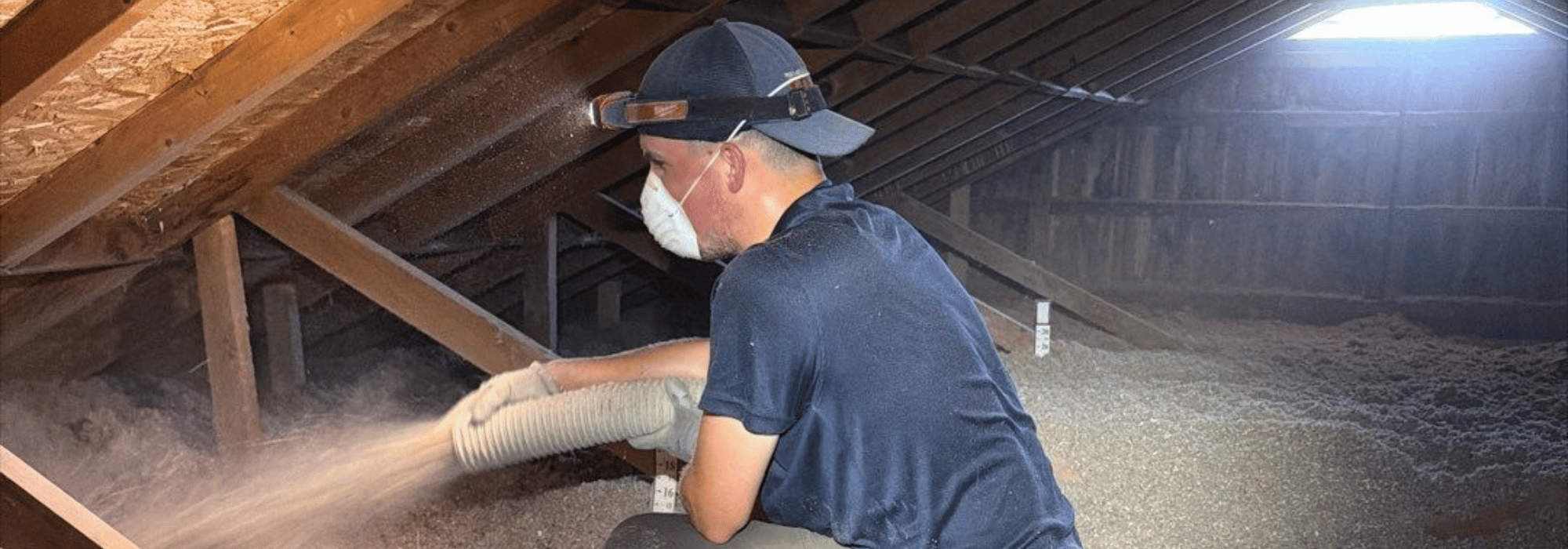
Upgrading attic insulation is one of the most effective fixes, and homeowners often find themselves deciding between two popular materials: cellulose and fiberglass. Both have insulated homes for decades. The difference is in how they perform once installed.
What R-Value Tells You
R-value measures how well a material resists heat flow. The higher the number, the better it slows heat from leaving your home in winter and creeping in during summer.Every material has a set R-value per inch, and the installed depth determines the total. That per-inch figure is where cellulose and fiberglass separate. According to the U.S. Department of Energy’s Building America program, settled loose-fill cellulose delivers roughly R-3.2 to R-3.8 per inch, while settled loose-fill fiberglass delivers about R-2.2 to R-2.7 per inch.
Central New York sits in climate zone 5, and ENERGY STAR recommends adding up to R-60 in an uninsulated attic here, or R-49 if you already have three to four inches in place.
What Is Cellulose Insulation
Cellulose is a loose-fill insulation made mostly from recycled paper fiber and treated with ammonium sulfate for fire resistance. The product we use at Fred F. Collis & Sons is non-toxic and at least 85 percent recycled newsprint, which makes it one of the more eco-friendly options available.How It Performs
The insulating work happens in the air pockets between the fluffed-up cellulose fibers. Insulation technicians use an insulation blower to distribute those fibers evenly into attic spaces and wall cavities, building a dense pack that meets your target R-value.That installation method is where cellulose earns its place:
- It forms a continuous layer with no seams, which delivers up to 25 percent better efficiency than batt insulation.
- It packs into small gaps and irregular spaces around joists, wiring, and framing that pre-cut products tend to miss.
- It helps with air sealing, reducing the drafts and heat loss that drive energy use up.
- It can be installed to any R-value target without the limits of pre-cut batts, and it performs for several decades.
What Is Fiberglass Insulation
Fiberglass is made from fine glass fibers spun into a light, fluffy material. It comes as pre-cut batts that fit between framing or as a blown-in loose fill installed with a blower. It is one of the most widely used insulation materials in the country.How It Performs
The material works by trapping air in the spaces between its fibers, and because still air conducts heat poorly, those pockets slow heat moving through the assembly. Thickness and density determine how much resistance the material provides, which is why the same product is sold in several R-values.
Insulation Is Only Part of the Job
Air leaks around the attic hatch, plumbing penetrations, and wall top plates let conditioned air escape no matter what sits on the attic floor. Pairing new insulation with proper air sealing is what locks in comfort and keeps energy use down through a Central New York winter.Fire Resistance and Safety
Fiberglass is made of glass, so it is naturally non-combustible. Cellulose is treated with ammonium sulfate, a fire retardant that gives the product we install strong fire resistance while keeping it non-toxic. Neither should give a homeowner pause when a trained crew installs it correctly.Cost and Long-Term Value
Both blown-in cellulose and fiberglass are cost-effective options. There is no single sticker price, because cost depends on your attic. The main drivers are its size measured by the square foot, how easy it is to access, how much air sealing is needed first, the material selected, the condition of any existing insulation, including removal, and added complexity from multiple rooflines or knee walls.Both blown-in cellulose and fiberglass are cost-effective options. Over time, however, better attic insulation reduces heating and cooling loads, lowers energy use, trims utility bills, and helps HVAC equipment last longer by taking some of the strain off it.
Upfront cost does not have to be a barrier either. New York programs like NYSERDA EmPower+ can cover part or all of a qualifying project, and financing is available. Our team walks homeowners through what they qualify for, starting with a free home energy assessment.
Which Insulation Is Right for Your Attic?
Blown-in cellulose fits most attics, and older homes built before modern air-sealing practices gain the most, since the dense-pack application reaches gaps that pre-cut batts leave open.The attic needs to be evaluated and air-sealed before anything is blown. A free home energy assessment through our attic insulation team tells us what fits your home best.
Count on Collis for High-Quality Attic Insulation
Fred F. Collis & Sons is a family-owned company that has served Central New York and the Mohawk Valley since 1936.We help with:
- Attic insulation and air sealing
- Blown-in cellulose/spray foam insulation
- Heating and cooling installation, repair, and maintenance
- Indoor air quality solutions
- Collis Club Membership service plans