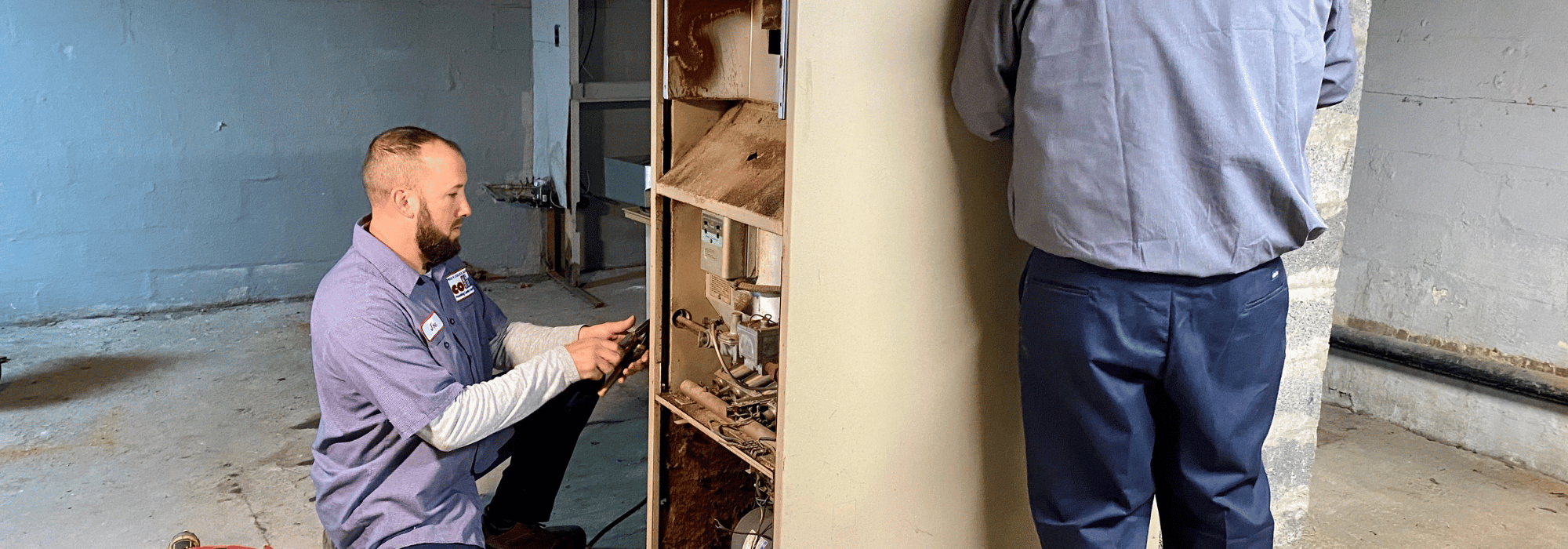
The fastest way to tell them apart is to look at what sits in the room. Supply vents in the floors or walls point to one system, and baseboard radiators along the wall point to the other.
Central New York winters keep both systems running for months at a time. Knowing which one you have makes repairs, upgrades, and regular maintenance easier to plan.
Furnace vs. Boiler: The Short Answer
A furnace burns fuel, warms a heat exchanger, and uses a blower fan to push hot air through ductwork into every room.A boiler heats water instead of air, then circulates that heated water through pipes to baseboard radiators or radiant flooring systems.
Both deliver consistent, reliable heat. The real difference is what carries that heat through the house. That single distinction explains almost everything else about how the two systems behave. Both are common residential heating equipment, and both come in high-efficiency models today.
| Feature | Furnace | Boiler |
|---|---|---|
| What it heats | Air | Water |
| How heat travels | Ducts and supply vents | Pipes to radiators or radiant floor heating |
| What you see in the room | Supply and return vents | Pipes to radiators or radiant floor heating |
| Shares ductwork with central air | Yes | No |
| Common fuels | Natural gas, oil, electric | Natural gas, oil |
How a Furnace Works
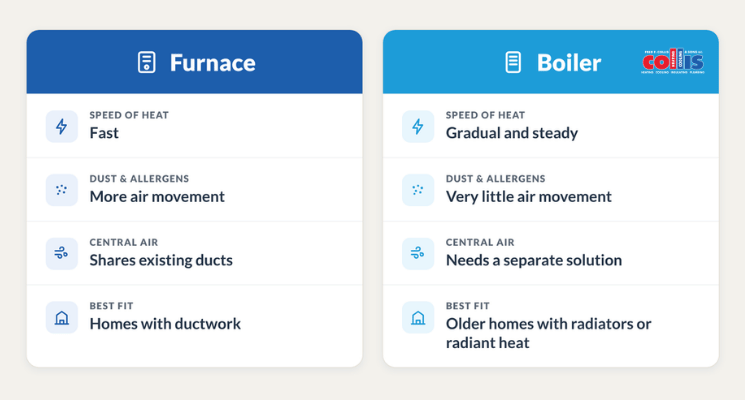
A furnace starts with a burner or a heating element that raises the temperature inside the unit. The heat exchanger then separates combustion gases from the air you breathe while transferring warmth to that air.From there, a blower fan sends warm air through the ducts and out the supply vents in each room. Return vents pull cool air back toward the unit to start the cycle again. Rooms warm up quickly with this setup because moving hot air responds fast to a thermostat call.
The Main Parts of a Furnace
- The burner creates the heat that starts the whole process.
- The heat exchanger transfers that heat to the air without mixing in exhaust.
- The blower fan and ductwork distribute warm air to each room in the house.
- The filter cleans the air on its way through the system.
Gas and Oil Furnace Options
A gas furnace is a common choice in homes with a natural gas line, and a high-efficiency furnace reaches the top of the efficiency range. An oil furnace is a familiar setup in Central New York homes, particularly where no gas line runs to the property.Collis services and installs both oil and gas furnaces, handles furnace repair and replacement, and offers fuel oil delivery so an oil furnace keeps running through the coldest stretches.
How a Boiler Works
A boiler heats water in a sealed vessel, and a circulator pump sends the heated water through a loop of pipes. As the hot water passes through baseboard radiators or tubing under the floor, it releases radiant heat into the room. The cooled water returns to the boiler system, and the cycle repeats.Boiler heat feels steady and even because objects and surfaces hold warmth longer than air does. A boiler system also runs at a lower temperature than a furnace, which is part of why the warmth feels gentler and less like a blast of hot air.
How Boiler Heat Reaches Your Rooms
- Baseboard radiators run along exterior walls and warm the air passing over their fins.
- Radiant floor heating places tubing underfoot so warmth rises evenly.
- Radiant flooring systems eliminate drafts because no blower fan is pushing air around.
How to Tell Which Heating Equipment You Have
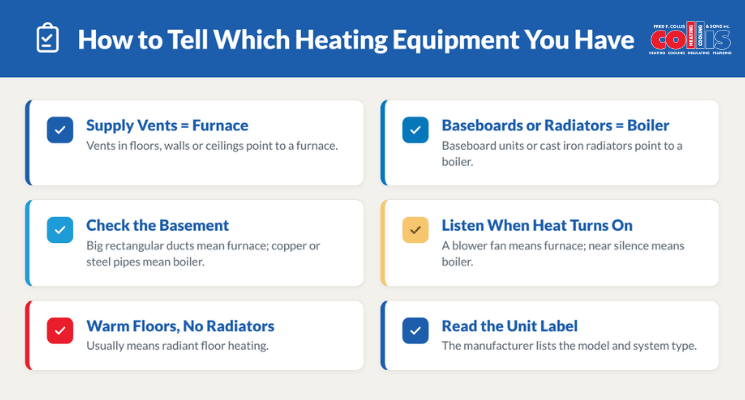
Six quick checks will help you identify what system you have.- Look for supply vents in the floors, walls, or ceilings, which point to a furnace.
- Look for baseboard units or cast iron radiators, both of which point to a boiler.
- Check the basement, since a furnace utilizes ductwork and a boiler utilizes pipes.
- Listen at startup, because a furnace runs a blower fan and a boiler stays quiet.
- Feel your floors, since warm floors with no radiators mean radiant floor heating.
- Read the label on the unit, where the manufacturer lists the model and system type.
Boiler vs. Furnace: Comfort, Efficiency, and Air Quality
Once you know which heating system you have, the next question is how it compares on the things homeowners actually notice. The monthly bill, the way a room feels, and the air moving through the house all come down to the differences between a boiler and a furnace.Energy Efficiency
Both systems are rated by annual fuel utilization efficiency, and modern high-efficiency models reach the 90 to 98.5 percent range. A boiler system circulates water at a lower temperature than a furnace that pushes hot air, and both reach high efficiency in modern equipment.Energy efficiency depends as much on sizing, installation, and insulation as it does on the equipment itself. An oversized unit in a leaky, drafty house will underperform no matter what the label says.
Comfort and Consistent Heat
A furnace heats a room quickly, though temperatures can swing between cycles. Boiler heat holds steady and avoids the blast of hot air that some homeowners dislike. Comfort preferences are in play here, and neither answer is wrong.Indoor Air and Dust
A furnace moves air constantly, which stirs up dust but also allows filtration and humidity control. A boiler moves no air at all, meaning there can be less dust circulation and there is no filter to change. Homes with a boiler often add indoor air quality equipment separately.Cost and Installation
A furnace installation is usually less expensive upfront and faster to complete in a home that already has ducts. A boiler system costs more to install but can potentially last longer with boiler maintenance done on schedule.Adding ducts to a home built for radiators is a major project, which is why most homeowners replace a boiler with another boiler and a furnace with another furnace.
Which System Is Better for Older Homes?
Many older homes across the Mohawk Valley were built around a boiler, and the radiators or radiant heat are still the most practical way to warm those rooms. Converting to a furnace means finding space for ducts, which is difficult in homes with plaster walls and finished attics.Upgrading the existing boiler to a high-efficiency model is often the better investment in colder climates. Along with the equipment, insulation and air sealing improve comfort in an older home no matter which heating equipment is installed.
A free home energy assessment from our team at Fred F. Collis & Sons can show where the house is losing the heat you already pay for.
Can You Get Central Air If You Have a Boiler?
A boiler cannot deliver cool air because it has no ducts and no blower fan. That does not rule out air conditioning, and there are two common paths forward.- Ductless mini-splits mount on the wall and deliver cooling in summer and heat in winter.
- A heat pump works alongside the boiler and handles both without adding ductwork.
Regular Maintenance for Each System
Proper maintenance looks different depending on which system you have, though the goal is the same in both cases.Furnace Maintenance
- A technician inspects the heat exchanger, cleans the burner, and tests safety controls.
- Fresh filters protect airflow and keep the blower from working harder than it should.
- Annual service before winter catches small problems while they are still inexpensive.
Boiler Maintenance
- A technician checks pressure, inspects the circulator pump, and tests safety controls.
- Bleeding trapped air out of the baseboard radiators restores even heat to cold rooms.
- Yearly boiler maintenance reduces breakdowns and extends the life of the equipment.
Count on Collis for Furnace and Boiler Service in Central New York
Fred F. Collis & Sons has served Central New York and the Mohawk Valley since 1936. We serve Utica, Rome, New Hartford, Frankfort, Syracuse, and the surrounding communities. Our NATE-certified technicians service both furnaces and boilers.Free estimates are available on new installations, and flexible financing helps make an upgrade affordable. Call 315-768-2323 or request service online to schedule an appointment.