That difference matters more here than it does in a milder climate. Central New York has a long heating season with cold winters and humid summers. The insulation that best fits those conditions is not always the cheaper one.
That is why Fred F. Collis & Sons installs closed-cell spray foam insulation. It is built to handle the cold CNY winters and the challenges found in many older homes throughout the area, helping homeowners create a more comfortable and efficient space.
Spray Foam Insulation Basics
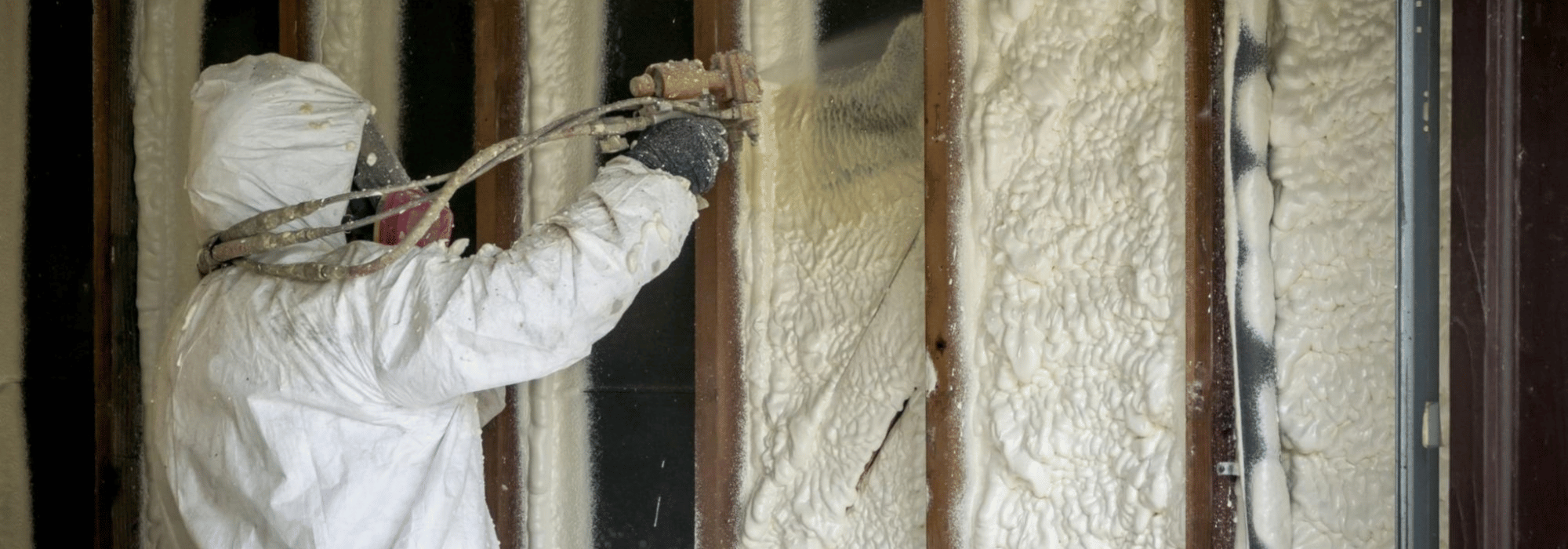
Spray foam is applied as a liquid and expands within seconds, filling gaps that traditional insulation can miss. It conforms to the space instead of being cut and fitted into it, so it works well in framing that is hard to reach. As it cures, it seals air leaks at the same time it insulates. That is why installers concentrate it where those leaks are worst. The finished foam becomes a permanent part of the structure rather than something a homeowner swaps out in a few years.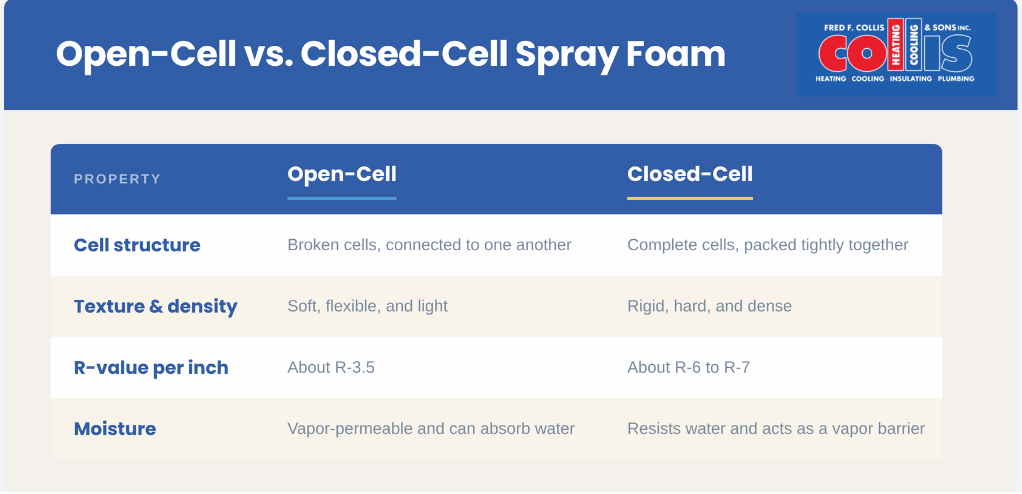
Open Cell Spray Foam Explained
Open-cell spray foam is a lightweight insulation option that exands significantly after application, allowing it to fill small gaps and hard-to-reach areas. Once cured, it stays soft and flexible, which helps absorb sound between rooms.Open-cell foam has a lower R-value, roughly R-3.5 per inch. Open-cell foam is also not a vapor barrier and can absorb water, which makes it a poor choice anywhere moisture is a concern.
Open-cell spray foam can be a good fit for certain applications, including:
- Lower cost per square foot
- Good sound dampening
- Filling irregular cavities well
Closed-Cell Spray Foam Explained
Closed-cell spray foam is denser and heavier than open-cell. The sealed cell structure makes the cured foam rigid, giving it a higher R-value, better moisture resistance, and added strength compared to open-cell foam.Higher R-Value in Less Space
Closed-cell foam delivers about R-6 to R-7 per inch, nearly double what open-cell provides. That means more insulating power in a thinner layer. In spots where depth is limited, like rim joists and crawl spaces, closed-cell foam reaches a high R-value without needing much room. Even at a 1-inch thickness, it outperforms a much thicker application of open-cell foam. Building up from there gives you maximum thermal resistance in areas where space is tight.Built-In Moisture and Vapor Barrier
Closed-cell foam resists water. At the proper thickness, it acts as both a moisture barrier and a vapor barrier, which blocks liquid water and slows water vapor from moving through the wall assembly. In Central New York basements and crawlspaces, where dampness is a year-round factor, that moisture protection is often the deciding reason homeowners choose it.Adds Strength to Your Home
Once cured, closed-cell foam creates a rigid layer that can add support to the surfaces where it is installed. This added durability makes it a long-lasting insulation choice for many homes. Closed-cell is the spray foam insulation solution our technicians install at Fred F. Collis & Sons. Combined with our air sealing services, it helps create a tighter, more comfortable home built to handle CNY weather.| Feature | Open Cell | Closed Cell |
|---|---|---|
| R-value per inch | ~R-3.5 | ~R-6 to R-7 |
| Moisture resistance | Absorbs moisture | Resists moisture |
| Vapor barrier | No | Yes (at proper thickness) |
| Air sealing | Yes | Yes |
| Structural strength | Minimal | Adds rigidity |
| Sound dampening | Better | Good |
| Best for | Soundproofing interior walls, lower budget, dry or mild climates | Crawl spaces, basements, rim joists, exterior walls, roof decks, high humidity or extreme cold and hot climates |
Why Closed-Cell Works Well in Central New York Homes
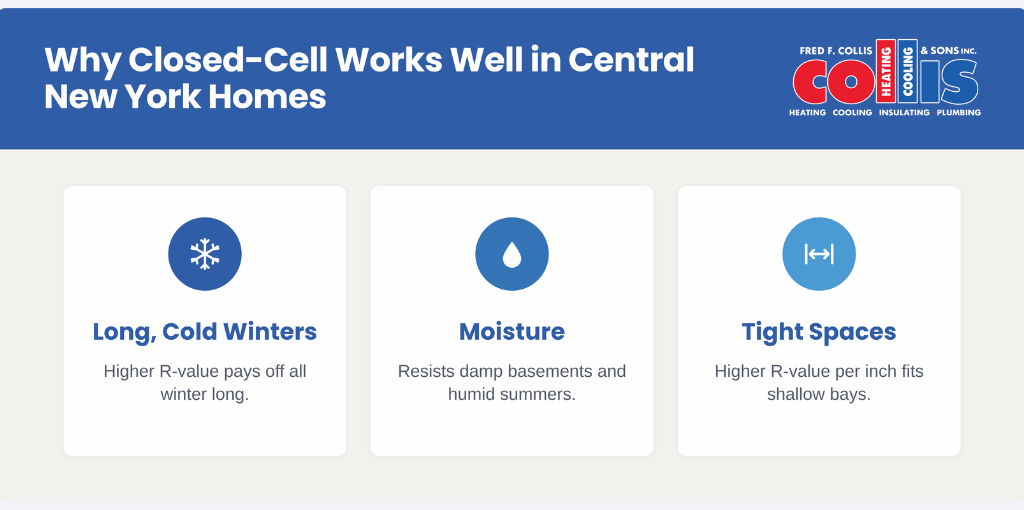
The heating season here is long and cold, so the higher closed-cell spray foam R-value pays off month after month. A wall that holds heat better keeps the furnace or boiler from running as often, and that steady efficiency adds up over a Central New York winter.Moisture is the second factor. Damp basements, humid summers, and crawlspaces built close to the ground all put water in play. The moisture resistance of closed-cell foam handles those conditions in a way open-cell foam simply cannot.
Space is the third consideration. Many older homes in the Mohawk Valley have rim joists, crawl spaces, and framing bays with little room for thick insulation. A higher R-value per inch lets closed-cell foam do the job where there is not enough depth for fiberglass batts or a heavy layer of open-cell foam. It is a common fit for both basement insulation and attic insulation projects.
Where Closed Cell Spray Foam Is Commonly Used
- Crawl spaces and rim joists
- Basement walls
- Roof deck and unvented conditioned attic assemblies
- Exterior walls
- Metal and pole buildings and other industrial applications
Closed Cell Spray Foam and Energy Efficiency
Closed-cell foam improves energy efficiency in two ways. It air seals the home so drafts and leaks shrink, and its high R-value slows heat loss through the walls themselves. Together, those effects take strain off the heating and cooling system, which can lower monthly energy costs.The material also lasts. Closed-cell foam holds its R-value and stays in place for decades, so it keeps performing long after the day it goes in.
The upfront cost is higher than open-cell foam, but New York offers programs that help offset it. The NYSERDA EmPower+ program and other state incentives can reduce what you pay out of pocket, and our team can walk you through which ones you qualify for. Request a free home energy assessment to get started!
Count on Collis for Closed-Cell Spray Foam Insulation
Fred F. Collis & Sons has served Central New York since 1936, with offices in Yorkville and Syracuse. Our NATE-certified technicians treat your home the way they would treat their own, and every estimate is free.We install closed-cell spray foam in homes across Utica, Rome, Syracuse, and the surrounding areas. If you want to know whether it is the right fit for your basement, attic, or crawl space, we can take a look and give you honest guidance.
Call 315-768-2323 to schedule your free estimate!