The truth is, a frozen air conditioner is a fairly common problem, and it’s almost always a sign that something has gone wrong inside your cooling system. The good news is that most of the causes are well-understood, and many are preventable.
Below, we’ll walk you through the most common reasons your AC freezes up, what you can do about it, and when it’s time to bring in an HVAC professional.
How Does an AC Unit Freeze Up?
Your AC system works by circulating refrigerant through an evaporator coil, which is located inside the indoor unit. As warm air from your home blows across the coil, the refrigerant absorbs the heat and carries it outside through the refrigerant lines to the outdoor unit, where it’s released. That process of heat transfer is what makes your home feel cool.When something disrupts that process, like reduced air flow across the coil, or a drop in refrigerant levels, the evaporator coil can get too cold. Moisture in the air starts to freeze on the coil’s surface, and the ice buildup compounds the problem. The more ice that forms, the less the system can function, which can eventually lead to further damage.
For a more detailed look at how air conditioners work, the U.S. Department of Energy has a helpful breakdown.

Most Common Reasons Your AC Is Freezing Up
There are several things that can cause a frozen AC unit. Let’s go through each one.Dirty or Clogged Air Filter
This is probably the most common reason for a frozen AC. A dirty air filter restricts the amount of air that can pass over the evaporator coil. Without proper airflow, the coil temperature drops too low, and the moisture that normally collects on the coil starts to freeze instead of draining away.The fix here is simple: check your air filter regularly and replace it when it’s dirty. How often you should replace it depends on the type of filter you’re using and a few other factors.
 If you have pets, allergies, or a dusty home, you may need to change your filter more frequently. Fred F. Collis & Sons carries a range of HVAC filters and can help you find the right one for your system.
Low Refrigerant Levels
Refrigerant is the substance your AC system uses to absorb and move heat. When refrigerant levels are low, the pressure inside the evaporator coil drops. That causes the coil to get abnormally cold… cold enough to freeze.It’s important to understand that low refrigerant doesn’t happen naturally over time. If your refrigerant level is low, it almost always means there’s a refrigerant leak somewhere in the system. This is not a DIY fix. A trained HVAC technician needs to find and repair the leak, then recharge the system with the correct amount of refrigerant.
Signs you may have a refrigerant leak:
- Your vents are blowing warm air instead of cold air
- You hear a hissing or bubbling sound near the indoor or outdoor unit
- Your energy bills have been climbing for no clear reason
- Ice is forming on the refrigerant lines or evaporator coil
Dirty Evaporator Coil
Even if you’re good about replacing your air filter, dust and grime can still build up on the evaporator coil over time. A dirty evaporator coil acts like a blanket over the surface, making it harder for the coil to absorb heat from the air passing over it. When the coil can’t absorb enough heat, its temperature drops and ice starts to form.Cleaning evaporator coils is a job best left to a professional, since the coils are delicate and located inside the indoor unit. This is one of the things a technician will take care of during a routine maintenance visit.
Blocked or Closed Vents and Registers
This one catches a lot of homeowners off guard. If vents or return registers in your home are blocked by furniture, curtains, rugs, or even closed dampers, it reduces the air flow through the system. Less air moving over the evaporator coil means the coil gets too cold and freezes up.Take a walk through your home and make sure all supply vents and return air registers are fully open and unobstructed. Even closing vents in unused rooms can throw off the balance of your HVAC system.
Malfunctioning Blower Fan
The blower fan is what pushes air across the evaporator coil. If it’s running at the wrong speed, has a failing motor, or stops working altogether, the result is restricted airflow.A blower fan issue can sometimes sound like a rattling or squealing noise coming from your indoor unit. If you hear something unusual, don’t ignore it. This type of problem requires an HVAC professional to diagnose and repair.
Thermostat Issues
Running your air conditioner at a very low setting for long stretches, especially overnight, can sometimes cause the evaporator coil to freeze. This is more likely when nighttime temperatures drop below about 60°F outside, because the system is working to cool air that’s already fairly cool.A malfunctioning thermostat can also cause problems. If the thermostat isn’t reading the temperature correctly, or if it’s not cycling the system off when it should, the AC may run nonstop, overcooling the coil and causing ice buildup.
A good rule of thumb: don’t set your thermostat below 68°F, and consider raising it a few degrees at night.
Problems with Refrigerant Lines
The refrigerant lines connect the indoor and outdoor units, carrying refrigerant back and forth. If these lines are damaged, kinked, or not properly insulated, it can affect refrigerant flow and pressure. That can cause the same kind of temperature drop in the evaporator coil that leads to freezing.A technician should inspect your refrigerant lines during regular maintenance to catch any issues early.
What to Do If Your AC Unit Freezes Up
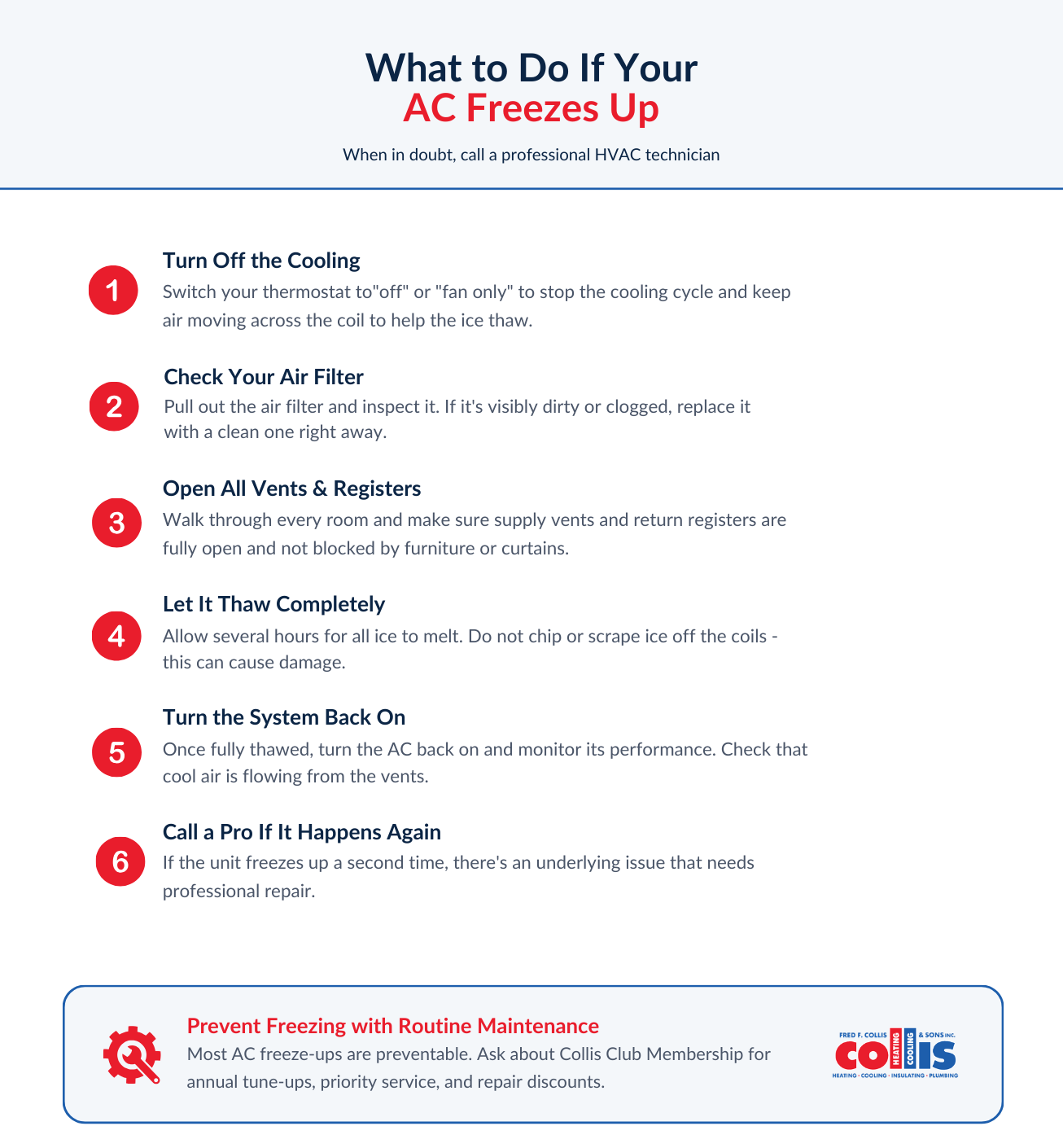 If you discover that your AC has frozen, here’s what to do:
- Turn off the cooling. Switch your thermostat to “off” or to “fan only.” This stops the cooling cycle while keeping air moving across the coil, which helps the ice thaw.
- Check your air filter. If it’s dirty, replace it.
- Open all vents and registers. Make sure nothing is blocked or closed throughout the house.
- Let the system thaw completely. This can take several hours. Don’t try to scrape or chip the ice off – you can damage the air conditioner coils.
- Turn the system back on. Once the ice is fully melted, turn the AC back on and monitor it.
- Call a professional if it happens again. If the system freezes up a second time, there’s likely an underlying issue that needs a trained technician’s attention.
How Regular Maintenance Prevents a Frozen AC
Most of the causes we’ve covered are things that develop gradually over time. Routine maintenance catches these small problems before they snowball into a frozen air conditioner or worse. During a typical AC maintenance visit, a technician will:- Check and adjust refrigerant levels
- Clean the evaporator and condenser coils
- Inspect the blower fan and motor
- Test the thermostat for accuracy
- Examine refrigerant lines for damage or poor insulation
- Replace or clean the air filter
- Check electrical connections and controls
When to Call an HVAC Professional
If your AC keeps freezing up after you’ve replaced the filter and checked the vents, the issue likely goes beyond what you can fix yourself. Refrigerant leaks, electrical problems, blower fan failures, and dirty internal components all require professional diagnosis and repair.Don’t keep running a frozen AC. Continuing to operate the system while it’s iced over puts serious strain on the compressor, and a compressor replacement is one of the most expensive AC repairs out there. The sooner you call an HVAC technician, the better your chances of a straightforward, affordable fix.
Count on Collis for AC Repair and Maintenance in Central New York
Fred F. Collis & Sons has been helping homeowners across Central New York and the Mohawk Valley stay comfortable since 1936. With offices in Utica and Syracuse, our team of NATE-certified technicians is ready to help with everything from a quick AC repair to a full system replacement.We’re upfront about pricing, no hidden fees, no surprises. And we stand behind our work with a written satisfaction guarantee. When it comes to air conditioning service you can trust, you can always Count on Collis.
Give us a call at 315-737-4143 or contact us online to schedule your appointment today.